AK-47
What is the AK-47 and how did the world's most famous assault rifle come to be?
AK-47 (Avtomat Kalashnikova) is the legendary Soviet assault rifle chambered in 7.62 × 39 mm, designed by Mikhail Timofeyevich Kalashnikov. Its development began after World War II, when the Soviet Union was looking for a new automatic infantry weapon chambered for an intermediate cartridge. Following the first prototypes, including the AK-46, a substantially redesigned weapon known as the AK-47 emerged in 1947. It was adopted by the Soviet Army in 1949 under the official designation AK. The foundation of its legendary reliability was its long-stroke gas piston system, rotating bolt, simple construction, and resistance to adverse conditions. The first production rifles featured a stamped steel receiver (Type 1), but problems with mass production technology at the time led to a switch to more expensive milled receivers (Type 2 and Type 3). The real manufacturing revolution came in 1959 with the modernized AKM (Avtomat Kalashnikova Modernizirovannyy), which returned to a lightweight stamped receiver, introduced a modified trigger mechanism, and, on its well-known variants, the characteristic slanted muzzle compensator. The AKM and its derivatives spread to dozens of countries and became some of the most widely produced small arms in history. Domestic variants were produced in countries including China (Type 56), Poland, Romania (PM md. 63), Hungary (AMD-65), Bulgaria, Yugoslavia (Zastava M70), and the former East Germany (MPi-KM). Although virtually all similar rifles are commonly referred to as AK-47s today, the original AK, the modernized AKM, and foreign variants differ significantly in their technical design.
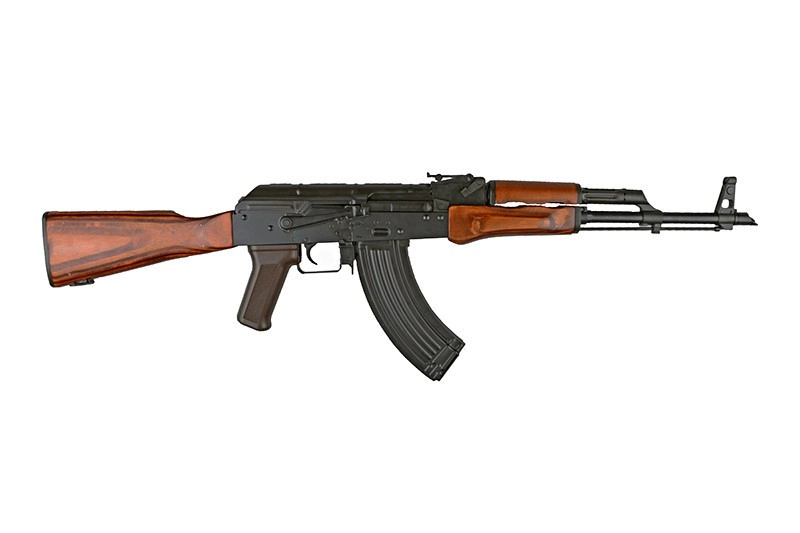
LCT AK-47 AEG
Four generations of Kalashnikov assault rifles – from the AK-47 to the AK-12
For clarity, the development of the AK (Kalashnikov) family can be divided into four main generations, reflecting changes in design, ammunition, and ergonomics. This is an approximate developmental classification rather than a standardized official designation used by the manufacturer. Despite more than seventy years of development, the entire family retains the fundamental design principles of the original Kalashnikov.
- 1st generation – AK-47 and AKM (7.62 × 39 mm)
The original AK adopted in 1949 and its AKM modernization from 1959 laid the foundation for the entire Kalashnikov family. Early AKs used stamped and later milled steel receivers, while the AKM brought a return to a lightweight stamped construction, a modified trigger mechanism, and the characteristic slanted muzzle compensator. This generation also includes the AKS and AKMS folding-stock variants and numerous foreign derivatives.
- 2nd generation – AK-74 and AK-74M (5.45 × 39 mm)
In 1974, the platform transitioned to a smaller, faster projectile with a flatter trajectory and lower recoil. A characteristic feature of the AK-74 is its distinctive two-chamber muzzle brake. It was followed by the AKS-74 with a folding stock, the compact AKS-74U for vehicle crews and special forces, and the modernized AK-74M from the early 1990s with black polymer furniture, a folding stock, and a side mounting rail for optics.
- 3rd generation – AK-100 series (5.45 / 5.56 / 7.62 mm)
From the 1990s onwards, export models based on the AK-74M were developed in various calibres and barrel lengths. The AK-101 and AK-102 use 5.56 × 45 mm NATO, the AK-103 and AK-104 are chambered in 7.62 × 39 mm, while the shortened AK-105 uses 5.45 × 39 mm. The experimental AK-107, AK-108, and AK-109 models used a balanced automatic recoil system designed to reduce weapon movement during automatic fire. The main goals of this generation were production standardization, modernization of materials, and expansion of the product range for foreign markets.
- 4th generation – AK-12, AK-15, and modernized AK-200 series
The most modern development branches of the Kalashnikov family place greater emphasis on ergonomics, adjustable stocks, and mounting options for optics and tactical accessories. The AK-12 (5.45 × 39 mm) and AK-15 (7.62 × 39 mm) were developed in connection with the modernization of the Russian Army's equipment under the Ratnik programme. They feature integrated Picatinny rails, modernized sights, and redesigned controls. They are complemented by the export-oriented AK-19 (5.56 × 45 mm NATO) and AK-308 (7.62 × 51 mm NATO). The AK-200 series represents a separate modernization branch that further develops the AK-100 design and adapts it to the requirements of the modern battlefield.
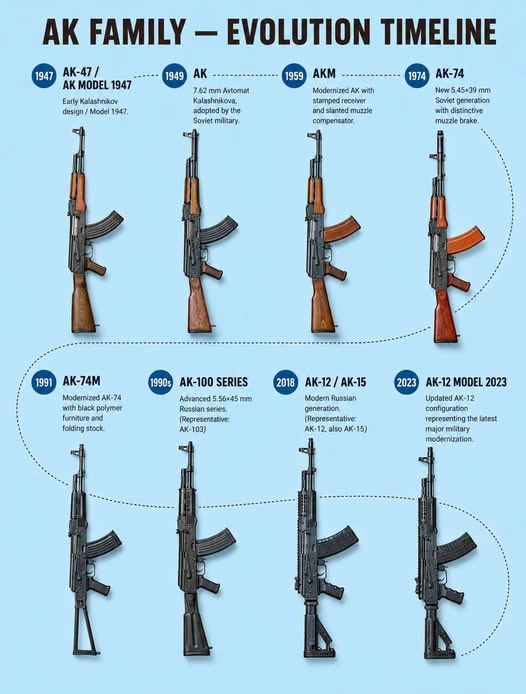
Evolution of the AK platform
AK-47 in airsoft – from Tokyo Marui and the legendary CYMA to steel E&L and LCT replicas
Airsoft AK-47 replicas are among the oldest and most popular electric airsoft guns ever made. The Japanese company Tokyo Marui played a major role in their history when it introduced an electric AK-47 with an AEG V3 gearbox in the 1990s, establishing a design standard subsequently adopted by many other manufacturers. The Chinese CYMA CM.028, with its predominantly plastic external body, later became a true legend of affordable airsoft, offering beginners a reliable electric AK at an accessible price. Even today, these unassuming plastic Kalashnikovs remind many experienced players of the early days of airsoft, and some examples may still be running in their original configuration after many years. Further development brought metal bodies, more realistic disassembly, and steel structural components, which gradually became established among manufacturers such as CYMA and D-Boys (DBOYS). Today, E&L Airsoft is an excellent choice for enthusiasts of realistic AK replicas, with its guns standing out for their robust steel bodies, authentic construction, and manufacturing techniques inspired by the production of real firearms. For demanding collectors, reenactors, and players seeking maximum authenticity, the Taiwanese brand LCT Airsoft represents the true holy grail of airsoft Kalashnikovs. It has become renowned for its precisely manufactured steel bodies, high-quality surface finishes, realistic dimensions, and exceptionally wide range of historical and modern AK variants. At ANAREUS CZ, you can find an extensive range of AK-47 airsoft rifles from E&L, LCT Airsoft, and other manufacturers – from classic AK-47 and AKM rifles with wooden furniture to modern tactical models for demanding MilSim events. Whether you are looking for an affordable steel AK or a highly authentic collector-grade replica of the legendary Kalashnikov, these two brands are among the most interesting choices in modern airsoft.
Powered by Froala Editor