Pupillary distance
Pupillary Distance (PD – Pupillary Distance) is the distance between the centers of the pupils, usually given in millimeters. This parameter is crucial for optical devices because it determines whether the image will be properly aligned, sharp, and comfortable without eye strain. Pupillary distance (PD) is therefore a key parameter for optical devices and NVG, defining how natural, sharp, and comfortable the image will be. A device with excellent PD adjustment is characterized by a wide adjustment range, stability, and instant image “alignment.” With NVG, correct PD is absolutely essential for safe movement, depth perception, and long-term use without fatigue.

Why is pupillary distance important?
Pupillary distance ensures that the optical axis of the device matches the position of the user’s eyes. If PD is not set correctly or is outside the device’s adjustment range, it can result in:
- eye strain and headaches,
- reduced depth perception,
- darkening at the edges of the image (vignetting),
- loss of sharpness or a “misaligned” image.
How can you recognize a device with excellent pupillary distance adjustment?
A high-quality optical or night vision device can be recognized by the following features:
- Wide PD adjustment range – typically around 52–74 mm, suitable for most users.
- Smooth and precise adjustment without play or unwanted movement.
- Fast image “alignment” – after putting the device on, you immediately see a clear image without searching for the ideal position.
- Stable image during head movement – the image does not break apart when walking or running.
With top-tier devices, correctly set PD is immediately noticeable – the image feels natural and does not cause fatigue.
Pupillary distance and NVG
Yes, pupillary distance is commonly used with NVG (Night Vision Goggles), especially with:
- binocular NVG (dual-tube systems),
- devices with articulating arms,
- bridge systems.
With NVG, PD is absolutely critical because it:
- affects comfort during long-term wear,
- has a direct impact on depth perception,
- prevents disorientation when moving in the dark.
High-quality NVG mounts and housings allow independent PD adjustment for each eye, which is standard on professional military systems.
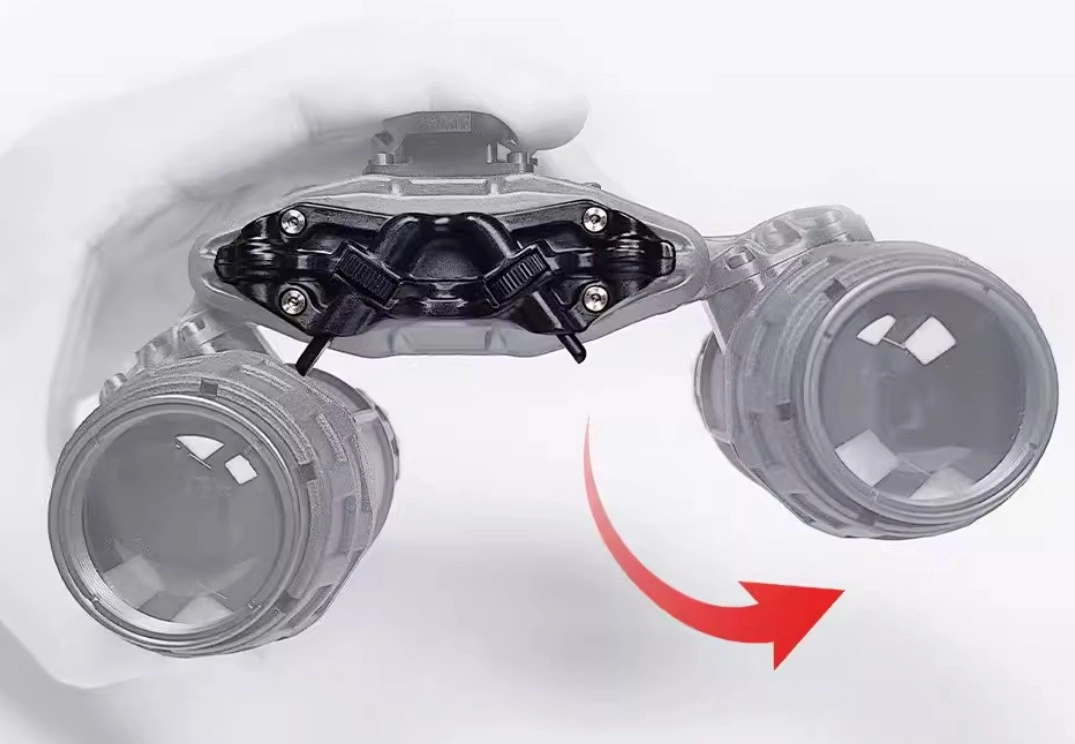
The difference between PD and eye relief
- Pupillary distance (PD) – the distance between the eyes (horizontal).
- Eye relief – the distance from the eye to the eyepiece (forward/backward).
Both parameters are important, but they address different aspects. The correct combination of PD and eye relief is the key to comfortable and safe use of optical devices.
Powered by Froala Editor