AMOLED
AMOLED (Active Matrix Organic Light Emitting Diode) is a type of modern display technology that uses organic light-emitting diodes capable of emitting light independently. Unlike traditional LCD displays, AMOLED does not require backlighting, as each pixel lights up on its own. Thanks to this, it delivers higher contrast, more vibrant colors, and lower power consumption. AMOLED is therefore an advanced display technology offering excellent image quality, low energy usage, and a modern design. Due to these characteristics, it is now one of the most widely used display types in smart electronics.
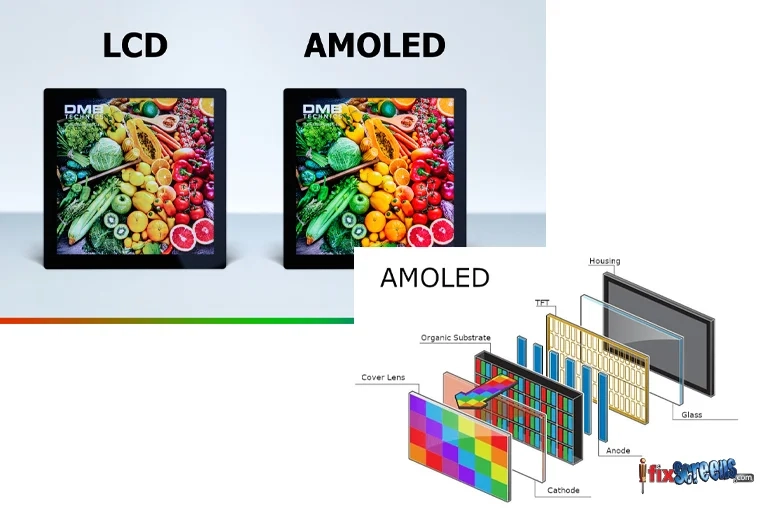
Comparison of LCD and AMOLED displays
How does AMOLED work?
- Self-emissive pixels: Each pixel is made of an organic diode that lights up independently.
- Active Matrix: Active matrix control ensures fast response times and precise control of individual pixels.
- No backlight: Black pixels are truly turned off, creating deep black tones.
Main advantages of AMOLED:
- Extreme contrast: True blacks and a very high contrast ratio.
- Vivid colors: Highly vibrant and rich color reproduction.
- Low power consumption: Uses less energy when displaying dark colors.
- Thin panel: Enables the production of very slim devices.
- Fast response time: Ideal for gaming and video.
Disadvantages of AMOLED:
- Risk of burn-in: Long-term display of static elements may cause image burn-in.
- Higher cost: AMOLED panel production is more expensive than LCD.
- Gradual pixel aging: Organic diodes lose brightness over time.
Where is AMOLED used?
- Smartphones: Both premium and mid-range devices.
- Smartwatches: Low power consumption and excellent readability.
- Tablets and laptops: Multimedia and productivity use.
- Automotive displays: Instrument clusters and infotainment systems.
AMOLED vs LCD:
Feature | AMOLED | LCD |
|---|---|---|
Backlighting | None | Required |
Black color | True black | Dark gray |
Power consumption | Lower (dark content) | Constant |
Panel thickness | Thin | Thicker |
Powered by Froala Editor