SOS
SOS (often written as S.O.S, although the dots are not official) is an international distress signal used to indicate an immediate threat to life and the need for urgent assistance. It is not an abbreviation of words, but a clearly recognizable signal in Morse code that can be easily transmitted by sound, light, or visual means. SOS is therefore a simple, universal, and globally understood distress signal that has been used for more than a century. Thanks to its clear structure and the ability to be transmitted by sound, light, or visually, it remains one of the most important elements of emergency signaling. Whether in the military, at sea, in the mountains, or in survival situations, SOS remains one of the most reliable ways to signal that lives are at risk.
Origin and introduction of SOS
The SOS signal was officially introduced in 1905 and internationally approved in 1906 at the Radiotelegraphic Conference in Berlin. It was put into practical use in 1908 as a standard maritime distress signal. Its adoption was linked to the development of wireless telegraphy and the need for a unified, quickly recognizable call for help. SOS has no patent – it was an international agreement aimed at safety rather than commercial use.
What does SOS mean?
Despite widespread myths, SOS does not mean “Save Our Souls” or “Save Our Ship.” These interpretations appeared later. The real reason for choosing SOS is purely technical:
- S = three short signals
- O = three long signals
- S = three short signals
This pattern (··· ––– ···) is symmetrical, simple, and unmistakable, which is crucial in an emergency.
Ways to signal SOS
SOS can be signaled in various ways depending on available means:
- By sound: whistling, knocking, horns, gunshots – three short, three long, three short.
- By light: flashlight, torch, beacon, spotlight – flashing in the same rhythm.
- By radio: originally via telegraphy, today replaced by modern distress channels.
- Visually: writing SOS on the ground, snow, beach, or grass. Hand signals used in abduction situations or when verbal communication is impossible.
Thanks to its simplicity, SOS can be signaled even without knowledge of Morse code.
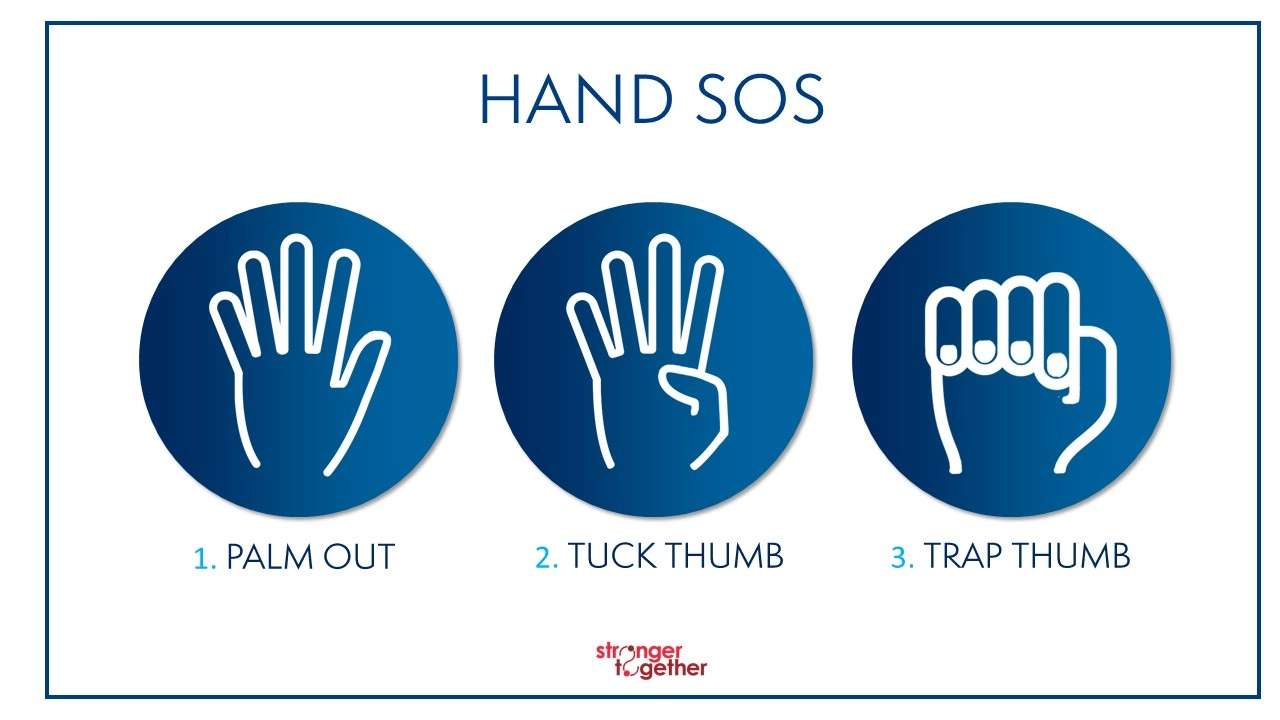
SOS hand signal (for kidnapping victims)
SOS in modern times
Although SOS has been officially replaced in maritime voice communication by the signal MAYDAY, it still remains:
- an internationally recognized symbol of distress,
- part of military, police, and rescue training,
- a basic element of survival and outdoor equipment,
- often integrated into flashlights, GPS devices, and emergency beacons.
Interesting facts about SOS
- SOS is one of the oldest international safety signals still in use today.
- It can be easily transmitted even under extreme conditions – with one hand, weak light, or tapping.
- SOS appears in pop culture, films, and games as a universal symbol of distress.
- Many tactical and outdoor flashlights feature an automatic SOS mode that saves energy and increases visibility.
Powered by Froala Editor