AK-100
What is the AK-100 and how did the third generation of Kalashnikov assault rifles come to be?
AK-100 (AK-100 series) refers to a family of modernized Russian Kalashnikov assault rifles developed in the first half of the 1990s by the design bureau of the Izhmash (IZHMASH) factory in Izhevsk. It followed the modernized AK-74M from 1991 and represented another significant stage in the development of Mikhail Kalashnikov's legendary design. Following the collapse of the Soviet Union, the manufacturer sought new foreign customers who used different types of ammunition. This led to the creation of a unified family of rifles in three calibres – 5.45 × 39 mm, 5.56 × 45 mm NATO, and 7.62 × 39 mm. The basic AK-101 to AK-105 models were completed in 1994. Compared with the older AKM and AK-74, they introduced primarily black polymer furniture, a side-folding polymer stock, a standardized side mounting rail for optics, and a high degree of parts commonality. At the same time, they retained the proven long-stroke gas piston system, rotating bolt, and characteristic durability of the AK family. The AK-100 series became the basis for further export models as well as experimental designs featuring a balanced automatic recoil system. An interesting fact is that there is no individual production rifle designated AK-100 – the designation refers to the entire model family, whose direct design predecessor is the AK-74M. Likewise, there is no standard production model designated AK-106.
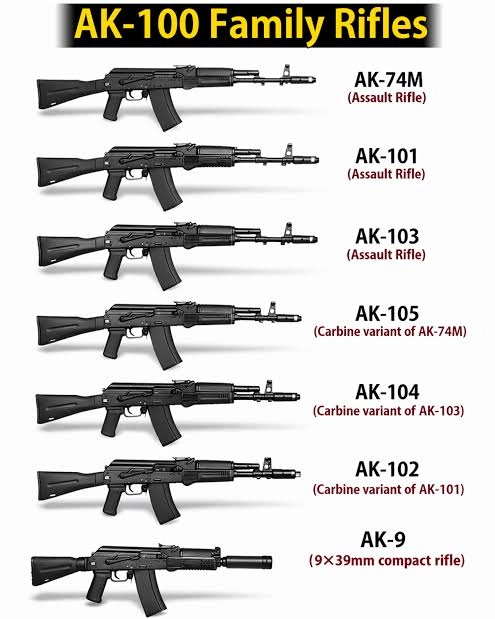
AK-100 and individual model series
Four generations of Kalashnikov assault rifles – from the AK-47 to the AK-12
For clarity, the development of the AK (Kalashnikov) family can be divided into four main generations, reflecting changes in design, ammunition, and ergonomics. This is an approximate developmental classification rather than a standardized official designation used by the manufacturer. Despite more than seventy years of development, the entire family retains the fundamental design principles of the original Kalashnikov.
- 1st generation – AK-47 and AKM (7.62 × 39 mm)
The original AK adopted in 1949 and its AKM modernization from 1959 laid the foundation for the entire Kalashnikov family. Early AKs used stamped and later milled steel receivers, while the AKM brought a return to a lightweight stamped construction, a modified trigger mechanism, and the characteristic slanted muzzle compensator. This generation also includes the AKS and AKMS folding-stock variants and numerous foreign derivatives.
- 2nd generation – AK-74 and AK-74M (5.45 × 39 mm)
In 1974, the platform transitioned to a smaller, faster projectile with a flatter trajectory and lower recoil. A characteristic feature of the AK-74 is its distinctive two-chamber muzzle brake. It was followed by the AKS-74 with a folding stock, the compact AKS-74U for vehicle crews and special forces, and the modernized AK-74M from the early 1990s with black polymer furniture, a folding stock, and a side mounting rail for optics.
- 3rd generation – AK-100 series (5.45 / 5.56 / 7.62 mm)
From the 1990s onwards, export models based on the AK-74M were developed in various calibres and barrel lengths. The AK-101 and AK-102 use 5.56 × 45 mm NATO, the AK-103 and AK-104 are chambered in 7.62 × 39 mm, while the shortened AK-105 uses 5.45 × 39 mm. The experimental AK-107, AK-108, and AK-109 models used a balanced automatic recoil system designed to reduce weapon movement during automatic fire. The main goals of this generation were production standardization, modernization of materials, and expansion of the product range for foreign markets.
- 4th generation – AK-12, AK-15, and modernized AK-200 series
The most modern development branches of the Kalashnikov family place greater emphasis on ergonomics, adjustable stocks, and mounting options for optics and tactical accessories. The AK-12 (5.45 × 39 mm) and AK-15 (7.62 × 39 mm) were developed in connection with the modernization of the Russian Army's equipment under the Ratnik programme. They feature integrated Picatinny rails, modernized sights, and redesigned controls. They are complemented by the export-oriented AK-19 (5.56 × 45 mm NATO) and AK-308 (7.62 × 51 mm NATO). The AK-200 series represents a separate modernization branch that further develops the AK-100 design and adapts it to the requirements of the modern battlefield.
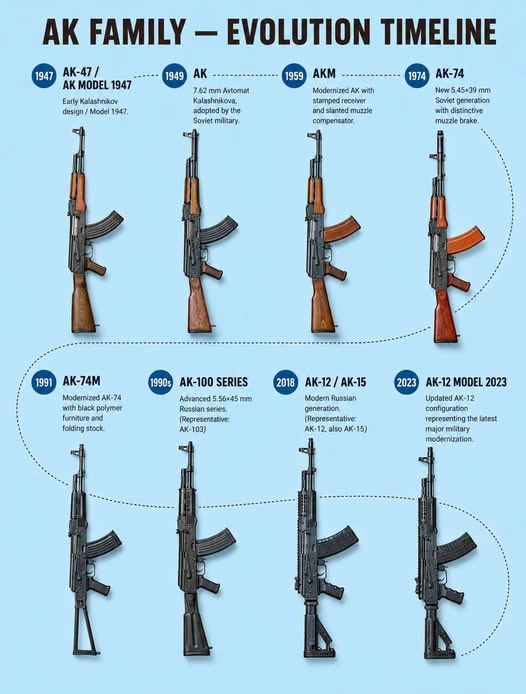
Evolution of the AK platform
AK-100 in airsoft – Specna Arms PRIME™, LCT, E&L and Arcturus
Airsoft replicas of the AK-100 series are among the most popular modern Kalashnikovs because they combine an authentic military appearance, durable construction, and extensive options for tactical customization. The compact AK-104 and AK-105 are particularly popular, making them suitable for dynamic airsoft games as well as realistic MilSim loadouts. For players primarily looking for top-tier performance straight out of the box, the Specna Arms J-Series PRIME™ is an excellent choice. For example, AK-105 PRIME™ models feature a steel body with a protective Nano Coating finish, reinforced V3 gearbox with high-quality upgrade parts, brushless motor, GATE ASTER V3 processor unit, and precision inner barrel with a modern MAGNUS™ AK hop-up chamber. These are therefore fully upgraded AEG rifles that do not require an immediate investment in expensive upgrades. Enthusiasts seeking maximum authenticity will also appreciate E&L Airsoft, whose robust steel construction and manufacturing techniques inspired by real firearm production provide a handling experience closer to the real steel original. For demanding collectors and reenactors, LCT Airsoft remains the proverbial holy grail of airsoft AKs, standing out for its precisely manufactured steel components, realistic dimensions, and extensive range of both classic and modern Kalashnikov variants. Another major manufacturer is Arcturus Tactical, which focuses on modern tactical AKs with high-quality external components, electronic systems, and advanced internals. At ANAREUS CZ, you can find a wide selection of AK-100 airsoft rifles from Specna Arms, LCT, E&L, and Arcturus. Whether you are looking for a realistic steel AK-105, a modern tactical build, or a high-performance AEG rifle with a processor unit and premium upgrade parts, you can choose a Kalashnikov ready for serious airsoft action.
Powered by Froala Editor