AK-12
What is the AK-12 and how did the fourth generation of Kalashnikov assault rifles come to be?
AK-12 (Avtomat Kalashnikova 2012) is a modern Russian assault rifle chambered in 5.45 × 39 mm, developed by Kalashnikov Concern (formerly IZHMASH) as the successor to the legendary AK-74 and AK-100 family. Its development began in 2011 in connection with the Russian Army's Ratnik modernization programme, which aimed to create a new generation of infantry weapons and equipment. The first AK-12 prototypes, unveiled in 2012 under the leadership of designer Vladimir Zlobin, introduced a significantly redesigned construction, ambidextrous controls, and modern ergonomics. However, military trials revealed problems with reliability, service life, and production costs. The original project was therefore fundamentally redesigned, with the new construction based on the proven AK-400 development platform, which itself evolved from previous generations of Kalashnikov rifles. The result was the AK-12 and AK-15, unveiled in 2016 and officially adopted by the Russian Army in 2018. The new generation retained the traditional long-stroke gas piston system, rotating bolt, and robust steel construction, while introducing major ergonomic improvements. Characteristic features included a folding and length-adjustable stock, ergonomic pistol grip, aperture sights, redesigned receiver cover with an integrated RIS rail, and a modern handguard allowing the mounting of tactical accessories. This makes it possible to directly install red dot sights, rifle scopes, flashlights, or laser aiming devices without the need for additional side mounts. The AK-12 design continued to evolve, with modernized versions from 2021 and 2023 introducing changes to the stock, sights, controls, muzzle device, and handguard. Although the AK-12 is significantly more modern than the original AK-47, it retains Mikhail Kalashnikov's fundamental design philosophy – simplicity, mechanical durability, and reliability in demanding conditions.
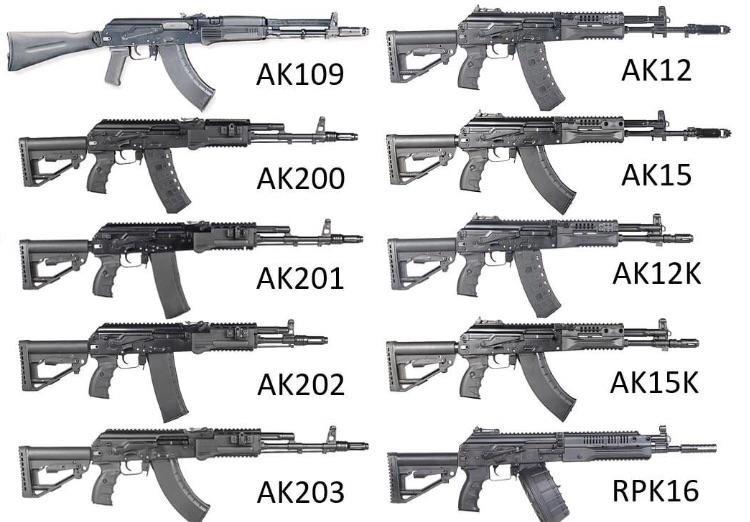
Overview of AK-200 models
AK-12, AK-15 and their derivatives – the modern generation of Kalashnikov rifles
The fourth generation of Kalashnikov rifles represents the transition from classic military AKs to modern modular weapons with integrated mounting systems, adjustable stocks, and ergonomic controls. The core of this generation consists of the AK-12 and AK-15, complemented by compact variants, export models, and separate modernization branches. For clarity, we also include the modernized AK-200 series in this development group, although its design is primarily based on the previous AK-100 series and it is not a direct derivative of the AK-12.
- AK-12 – standard assault rifle (5.45 × 39 mm)
The standard model of the new generation, adopted in 2018. It uses an approximately 415 mm barrel, a folding telescopic stock, aperture sights, and a modernized handguard with mounting rails. Compared with the AK-74M, it primarily offers improved ergonomics and easier installation of optics. The original production version allowed semi-automatic fire, fully automatic fire, and two-round burst fire. The AK-12 became the basis for further modernizations and derivative models.
- AK-15 – modern Kalashnikov in the classic calibre (7.62 × 39 mm)
Its design is based on the AK-12, but it uses the traditional 7.62 × 39 mm cartridge already familiar from the original AK-47 and AKM. It retains the modern ergonomics, mounting rails, and adjustable stock while allowing the use of compatible magazines from older AKM and AK-103 rifles. The AK-15 is intended for users who prefer the traditional 7.62 mm calibre in a modernized design.
- AK-12K and AK-15K – compact carbines (5.45 × 39 mm / 7.62 × 39 mm)
Shortened variants of the standard AK-12 and AK-15 rifles, developed for situations where smaller dimensions and easier handling are important. They use an approximately 290 mm barrel, a more compact front end, and retain the modern controls and folding stock. In terms of their role, they are counterparts to the compact AK-104 and AK-105 of the previous generation.
- AK-19 – export variant for NATO (5.56 × 45 mm NATO)
A modern export rifle unveiled in 2020 that adapts the AK-12 design to standard NATO ammunition. It is intended primarily for foreign armed forces and customers using the 5.56 × 45 mm calibre. It features modernized ergonomics, a folding adjustable stock, mounting rails, and a different muzzle device designed to accept a compatible suppressor.
- AK-308 – powerful export rifle (7.62 × 51 mm NATO)
An interesting derivative of the modern Kalashnikov design family, unveiled in 2018. Unlike the standard AK-12 and AK-15 assault rifles, it uses the significantly more powerful 7.62 × 51 mm NATO rifle cartridge. This requires a reinforced construction, larger magazine, and modified internal mechanisms. The AK-308 represents an attempt to expand the modern Kalashnikov platform into the category of more powerful semi-automatic and automatic rifles for foreign markets.
- AK-12 SP – special modernized variant (5.45 × 39 mm)
A development variant unveiled in 2020 and focused on the requirements of special forces. It introduced redesigned controls, including an ambidextrous fire selector, the option to use a raised cheek rest, and other ergonomic improvements. Unlike the original AK-12, it did not feature a two-round burst mode. Some of its design principles later influenced further modernizations of the standard rifle.
- AK-12 (2021) – first major modernization
The modernized version introduced a redesigned stock, a more ergonomic pistol grip, and a more compact rear aperture sight, freeing up more space on the upper RIS rail for mounting optics. These modifications responded to experience gained with the first production version and were gradually incorporated into subsequent production.
- AK-12 (2023) – latest major modernization
A redesigned version developed on the basis of experience gained from combat deployment. It introduced a new safety and fire selector mechanism with improved ambidextrous operation, modified aperture sights, a modernized handguard, and a new muzzle device. Another significant change was the removal of the two-round burst mode, meaning the new version uses only semi-automatic and fully automatic fire. The receiver cover mounting system and several other design details were also modified.
- AK-200 series – parallel modernization branch (5.45 / 5.56 / 7.62 mm)
A separate family of modernized rifles based primarily on the AK-100 design. It includes the AK-200 (5.45 × 39 mm), AK-201 and AK-202 (5.56 × 45 mm NATO), AK-203 and AK-204 (7.62 × 39 mm), and AK-205 (5.45 × 39 mm). It combines the proven mechanism of older Kalashnikov rifles with modern stocks, ergonomic accessories, and mounting rails. One particularly important model is the AK-203, which became the basis for licensed production for the Indian Armed Forces. Although the AK-200 series overlaps chronologically with the AK-12, it represents a separate development branch.
The modern AK-12 family also includes other design derivatives, such as the RPK-16 light machine gun, which was based on a similar development platform and shared many of the same design principles. Individual models differ in calibre, barrel length, ergonomics, and intended use, but they all share the goal of adapting the traditional Kalashnikov design to the requirements of modern armed forces.
Four generations of Kalashnikov assault rifles – from the AK-47 to the AK-12
For clarity, the development of the AK (Kalashnikov) family can be divided into four main generations, reflecting changes in design, ammunition, and ergonomics. This is an approximate developmental classification rather than a standardized official designation used by the manufacturer. Despite more than seventy years of development, the entire family retains the fundamental design principles of the original Kalashnikov.
- 1st generation – AK-47 and AKM (7.62 × 39 mm)
The original AK adopted in 1949 and its AKM modernization from 1959 laid the foundation for the entire Kalashnikov family. Early AKs used stamped and later milled steel receivers, while the AKM brought a return to a lightweight stamped construction, a modified trigger mechanism, and the characteristic slanted muzzle compensator. This generation also includes the AKS and AKMS folding-stock variants and numerous foreign derivatives.
- 2nd generation – AK-74 and AK-74M (5.45 × 39 mm)
In 1974, the platform transitioned to a smaller, faster projectile with a flatter trajectory and lower recoil. A characteristic feature of the AK-74 is its distinctive two-chamber muzzle brake. It was followed by the AKS-74 with a folding stock, the compact AKS-74U for vehicle crews and special forces, and the modernized AK-74M from the early 1990s with black polymer furniture, a folding stock, and a side mounting rail for optics.
- 3rd generation – AK-100 series (5.45 / 5.56 / 7.62 mm)
From the 1990s onwards, export models based on the AK-74M were developed in various calibres and barrel lengths. The AK-101 and AK-102 use 5.56 × 45 mm NATO, the AK-103 and AK-104 are chambered in 7.62 × 39 mm, while the shortened AK-105 uses 5.45 × 39 mm. The experimental AK-107, AK-108, and AK-109 models used a balanced automatic recoil system designed to reduce weapon movement during automatic fire. The main goals of this generation were production standardization, modernization of materials, and expansion of the product range for foreign markets.
- 4th generation – AK-12, AK-15, and modernized AK-200 series
The most modern development branches of the Kalashnikov family place greater emphasis on ergonomics, adjustable stocks, and mounting options for optics and tactical accessories. The AK-12 (5.45 × 39 mm) and AK-15 (7.62 × 39 mm) were developed in connection with the modernization of the Russian Army's equipment under the Ratnik programme. They feature integrated Picatinny rails, modernized sights, and redesigned controls. They are complemented by the export-oriented AK-19 (5.56 × 45 mm NATO) and AK-308 (7.62 × 51 mm NATO). The AK-200 series represents a separate modernization branch that further develops the AK-100 design and adapts it to the requirements of the modern battlefield.

Evolution of the AK platform
AK-12 in airsoft – steel LCT, E&L with GATE ASTER V3 and Arcturus FE™
Airsoft replicas of the AK-12 and AK-15 represent the modern form of the legendary Kalashnikov, combining an authentic military appearance with the ergonomics of contemporary tactical rifles. Characteristic features include a steel body, RIS handguard, upper mounting rail on the receiver cover, folding telescopic stock, and modern polymer accessories. For players demanding maximum authenticity to the real steel original, LCT Airsoft ranks among the absolute best. The Taiwanese manufacturer offers realistic replicas of the AK-12 (LCK-12) and AK-15 (LCK-15) with precisely manufactured steel bodies, high-quality surface finishes, and robust construction inspired by real firearms. Among enthusiasts of airsoft AKs, LCT is rightly regarded as the holy grail of realistic construction, particularly thanks to its authentic dimensions, structural strength, and exceptional attention to detail. An excellent alternative is E&L Airsoft, whose Essential series AK-12 models use robust steel bodies manufactured using techniques inspired by real firearm production. For more demanding players, E&L AK-12 Essential versions with a GATE ASTER SE V3 processor unit, reinforced V3 gearbox, quick spring change system, and high-quality internal components are also available. The ASTER unit enables advanced trigger settings, active brake, pre-cocking, Binary mode, and other functions that significantly improve trigger response and customization options. The third major manufacturer is Arcturus Tactical, which offers a broad family of modern AK-12, AK-12K, and updated AK-12 variants. Models equipped with the Arcturus FE™ (Fire Control Electronics) electronic unit in particular combine durable steel construction with modern fire control, programmable modes, active brake, pre-cocking, and electronic battery protection. Selected Arcturus versions also feature QPQ surface treatment of steel components, precision inner barrels, and high-quality internal components, making them an excellent choice for players looking for a high-performance modern AK straight out of the box. At ANAREUS CZ, you can find AK-12 airsoft rifles and their modern variants from LCT, E&L, and Arcturus. Whether you are looking for a collector-grade steel replica, a robust AK-12 with a GATE ASTER V3 unit, or a technologically advanced Arcturus FE™, you can choose a Kalashnikov that combines the legendary design with modern airsoft performance.
Powered by Froala Editor